

Bernedoodle Guide
Bernedoodle Temperament and Personality
Aka’s Bernedoodles, Akron, Ohio. Updated 28 October 2026.
People ask us what a Bernedoodle is actually like before they ask about anything else, and it is a fair place to start. The pattern we and most owners see is an affectionate, people-focused, slightly goofy dog, clever on the Poodle side and gentle and steady on the Bernese Mountain Dog side. We will not pretend that is a guarantee, though. A Bernedoodle is a cross, not an AKC breed with a written standard, so each puppy lands somewhere between its two parents and no two are identical.
Below we walk through the things that shape daily life with one: energy, brains, barking, training, house training, children, other animals, apartment living and being home alone. If you are still getting your head around the cross itself, start with what a Bernedoodle is, and when you want to meet puppies, see the puppies available at Aka’s Bernedoodles.
What is the Bernedoodle personality like?
The easiest way to picture it is to look at who the puppy comes from. The AKC describes the Bernese Mountain Dog as good-natured, calm and strong, a Swiss farm dog that pulled carts and drove cattle. It describes the Poodle as active, proud and very smart. A Bernedoodle takes a bit from each, which is why we describe ours as sweet and social, with more bounce than a Bernese and more softness than a Poodle.
The same handful of traits comes up again and again:
- Affectionate and happiest near their people, often trailing you from room to room.
- Friendly with visitors, though a few lean shy or reserved with strangers, usually the ones who take after the Bernese side.
- Playful well into adulthood, with a clownish puppy phase that can run two or three years.
- Sensitive to tone of voice. Harsh corrections tend to backfire with this cross.
Because the cross mixes two different dogs, littermates can differ. One puppy may be a calm lap-leaner and the next a nonstop wriggler. Spending time with a puppy and, where we can arrange it, its parents will always tell you more than a general description.
Do Bernedoodles bark a lot?
Not usually, in our experience. Bernedoodles are not a yappy cross, and plenty are fairly quiet indoors. They will sound off for a visitor, a delivery or a squirrel, and the Bernese watchdog streak means even a medium-sized dog can produce a deep, impressive woof. Smaller Bernedoodles tend to pitch higher and sound more excitable.
When barking does become a problem, there is almost always a cause you can work on:
- Boredom, which eases with more exercise and more to do.
- Loneliness or anxiety when left, which needs gradual practice with short absences.
- Attention seeking, which grows if barking earns eye contact, talking or treats.
- Alerting at windows, which you can cut down by blocking the view or teaching a quiet cue.
We suggest teaching a "thank you, enough" routine early: acknowledge the alert once, call the dog to you, reward calm. Shaping that in a young puppy is far easier than undoing it in a two-year-old.
Are Bernedoodles high energy?
Moderate to high is the honest answer, and it leans heavily on size and on which parent a dog favors. A Bernese is a working breed content with a steady walk and some play. A Poodle, especially a Standard, was bred as a retrieving water dog and has stamina to burn. The cross usually sits between the two: happy with a long walk and a game of fetch, then ready to flop down for a few hours.
As a rough guide, plan on:
- About 45 minutes to an hour of exercise a day for most adults, split between walks and play.
- Shorter, more frequent outings for puppies, since young joints should not be pounded by long runs or forced jumping.
- Mental work alongside the physical: food puzzles, scent games and short training sessions burn off energy a walk will not touch.
The energy peak usually hits in adolescence, from about six months to two years, when a Bernedoodle can act like it has forgotten everything it learned. It passes. We find dogs settle noticeably by two to three years old. Smaller Bernedoodles can seem busier than standards simply because small dogs move faster for the same effort, so size alone will not tell you the energy level. For how big each size gets, see the Bernedoodle size and weight chart.
Are Bernedoodles smart, and are they stubborn?
Smart, yes. Poodles are widely rated one of the most intelligent and trainable breeds, and a Bernedoodle usually inherits that quick mind. They pick up routines fast, which is a gift when you are teaching a good habit and a headache when you accidentally teach a bad one. A puppy that gets a treat once for barking at the fridge will remember.
The stubborn streak is the Bernese contribution, and it shows up as softness more than defiance. A Bernese can be slow to commit and may simply stand still if it does not see the point. In a Bernedoodle that often looks like a dog who understands the cue perfectly and is weighing whether to bother.
What works for us:
- Reward-based training with small, tasty treats and a cheerful voice.
- Short sessions of five to ten minutes, ended while the dog still wants more.
- Variety, because a clever dog bored by repetition will invent its own games.
What does not work is repeated nagging, long drills or anger. The cross is tender enough that a scolding can make a dog shut down rather than try harder.
Are Bernedoodles easy to train?
Generally yes, as long as you take easy to mean quick, not automatic. Their intelligence and desire to please make them fast learners, and most do well in a basic puppy class. Training is mostly consistency, timing and starting early, and that matters more with the larger sizes. A 90 pound adult that pulls on the leash or jumps up is hard to manage, and a 14 week old puppy doing the same thing is cute, so train the behavior you want to see in the adult.
A sensible order of priorities:
- Name, sit, down and come, taught in short sessions in a quiet room, then outdoors.
- Loose leash walking, started before the dog is strong enough to drag you.
- Calm greetings: four paws on the floor means the person says hello.
- Handling practice for paws, ears, mouth and brushing, which makes vet visits and grooming easier. See the Bernedoodle grooming guide for what that coat demands.
Socialization counts for as much as obedience. Between about 8 and 16 weeks, a puppy should meet a wide range of people, surfaces, sounds and friendly, vaccinated dogs, always at a pace the puppy is comfortable with. Ask your vet how to do this safely before vaccines are finished.
Are Bernedoodles good with kids and other pets?
They are widely seen as good family dogs, and we agree. The Bernese side brings patience and gentleness, the Poodle side brings playfulness. Most Bernedoodles enjoy children, and many are happy with other dogs and with cats they are raised alongside.
The caveats are practical rather than about temperament:
- Standard Bernedoodles are large and clumsy as adolescents. A friendly lean can knock over a toddler.
- Puppies mouth and jump. Teach children to stay calm and to leave a sleeping or eating dog alone.
- Never leave a young child and a dog together unsupervised, whatever the breed.
- The Bernese drove cattle and Poodles were bred to retrieve, so some chasing instinct is possible. Introduce cats and small animals slowly and give them escape routes.
Aggression is not a typical Bernedoodle trait. When it does show up it usually traces to poor socialization, fear, pain or a lack of boundaries, which is why early exposure, and a vet check for any sudden change in behavior, matter.
How do you house train a Bernedoodle puppy?
Bernedoodles are typically average to good at house training: smart enough to catch on quickly, but still puppies with small bladders. Expect accidents for the first few months and a reliable dog somewhere around six months, sometimes later for the smaller sizes, which have smaller bladders and need to go more often.
- Take the puppy out first thing, after every meal, after naps, after play and last thing at night.
- Go to the same spot, wait quietly, and reward within a couple of seconds of finishing.
- Use a crate sized so the puppy can stand, turn and lie down but not use one end as a bathroom.
- Supervise freely roaming time. If you cannot watch, the puppy is in the crate or a pen.
- Clean accidents with an enzyme cleaner, and never punish after the fact.
A common rule of thumb is that a young puppy can hold it for about one hour for each month of age, plus one, and no more than that. Overnight, expect a trip out or two for the first weeks.
Can a Bernedoodle be left alone?
For short periods, yes, with practice. Bernedoodles were crossed to be companions, and many form strong attachments that make long, regular absences hard. A dog left alone for eight or nine hours every weekday with no break is a poor match for this cross.
Build up gradually. Start with minutes, then stretch it out while the puppy is calm. Give a chew or stuffed toy, leave without fuss and come back without fuss. If the household is empty most of the day, a midday walker, a dog sitter or doggy daycare will do more than any gadget. Signs of real distress, such as drooling, destruction near doors or constant howling, are worth raising with a trainer or vet early.
Are Bernedoodles good apartment dogs?
They can be, mainly the smaller ones. A mini or tiny Bernedoodle that gets daily walks and mental stimulation usually adapts well to apartment life, and their moderate barking helps with neighbors. A standard Bernedoodle can live in an apartment too, but it needs more room to turn around, a way to burn off energy daily, and a building with an elevator or manageable stairs, because carrying a large dog is not realistic. Look at the mini Bernedoodle and standard Bernedoodle pages to compare sizes. The deciding factor is almost always exercise and company, not square footage.
Quick Answers
01Is there a temperament difference between mini and standard Bernedoodles?
Not in a reliable way. Both sizes share the same two parent breeds, so personality varies more from dog to dog than from size to size. Smaller dogs may seem busier and louder, and larger ones slower to mature.
02At what age do Bernedoodles calm down?
Most begin to settle between two and three years old, after the adolescent phase. Steady exercise and training in the meantime make that stretch much easier.
03Do Bernedoodles like to cuddle?
Most do. They are people-oriented dogs that like physical closeness, and many lean against you or try to sit on your lap regardless of how big they have become.
04Are Bernedoodles friendly with strangers?
Usually, though some are reserved. A puppy that is socialized early and often tends to grow into a confident, polite adult.
05Are male or female Bernedoodles calmer?
There is no firm evidence that one sex is calmer. Training, exercise and the individual puppy matter far more than whether it is a boy or a girl.
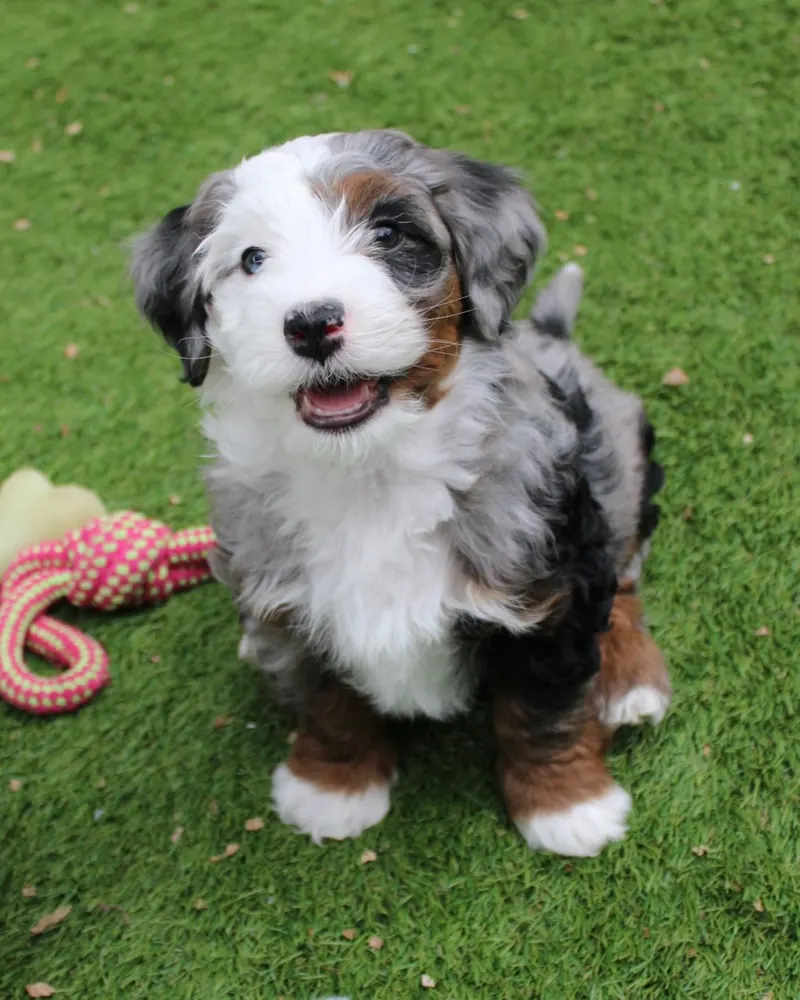
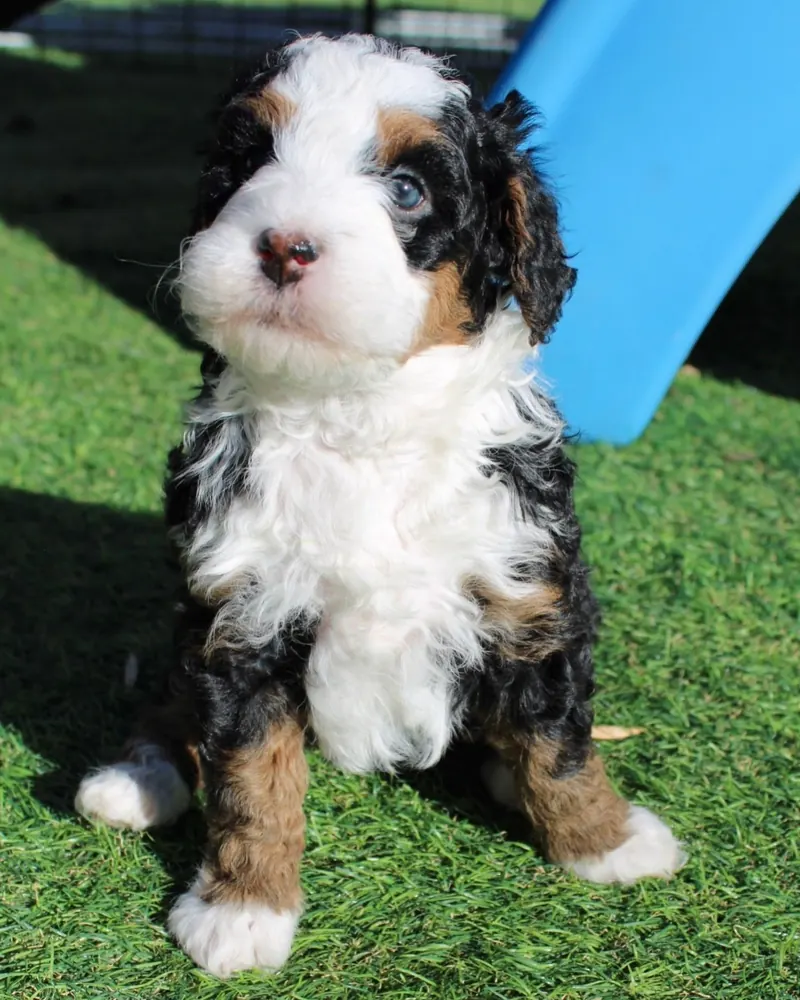
Bernedoodle Puppies Available Now

Keep Reading
 How Long Do Bernedoodles Live?How long do Bernedoodles live? The commonly quoted life expectancy, what the Bernese and Poodle parents tell us, mini...Read the guide
 Do Bernedoodles Shed?Do Bernedoodles shed? The hypoallergenic claim first, then how coat type, furnishings and generation shift the odds, with...Read the guide
Bernedoodle Health Problems and Health IssuesThe Bernedoodle health issues worth knowing, from hip dysplasia and cancer to eye and skin problems, the tests that...Read the guide
What Is a Bernedoodle?A Bernedoodle is a Bernese Mountain Dog crossed with a Poodle.Read the guide
How Big Do Bernedoodles Get? Full Grown Size and WeightA breeder's straight look at full grown Bernedoodle size: toy, mini and standard weights, a growth chart by age, and how...Read the guide
When You Are Ready
Thinking About a Bernedoodle Puppy?
See the puppies available now, or ask us anything about the breed.